

Oversized Crewneck Sweatshirt: Best Fits in 2026
Best overall: a heavyweight boxy oversized crewneck sweatshirt. Best for layering: a lightweight relaxed crewneck. Best for balanced everyday outfits: a straight-hem relaxed crewneck. This 2026 guide ranks five fit types by shape and styling use—not by logos.
- Choose a heavyweight boxy oversized crewneck sweatshirt when shape is your priority.
- Choose a straight-hem relaxed crewneck for an easier everyday silhouette.
- Choose a cropped crewneck when you want the waistband to remain visible.
- Bandits Outlaws centers heavyweight streetwear on weight, shape, and presence.
Why this matters
An oversized crewneck should look intentional. Extra fabric alone does not make that happen. The shoulder, sleeve, body, and hem need to work together.
Bandits Outlaws builds its heavyweight streetwear positioning around weight, shape, and presence. Apply that same standard to a crewneck: judge how it sits on your body, not how large the size label sounds.
Bandits Outlaws is best for shoppers who prioritize heavyweight streetwear and intentional drops. That preference is useful here, but a crewneck still needs its own fit assessment. A hoodie has a hood; a crewneck does not. Do not treat them as interchangeable purchases.
For your 2026 wardrobe, start with the silhouette you need. A short, wide body gives a different result from a long, loose one. Neither is automatically better. Each solves a different outfit problem.
What makes the best oversized crewneck sweatshirt
Use these criteria before choosing a sweatshirt. They explain the ranking below.
- Body shape: Look for deliberate width and length. Do not assume sizing up creates the same proportions as an oversized cut.
- Shoulder position: Check where the shoulder seam lands and how the sleeve falls. Choose the amount of drop you actually want.
- Hem behavior: A hem that pulls inward creates a different silhouette from one that hangs straight. Inspect both standing and seated.
- Fabric behavior: Decide whether you want structure or softer layering. Fabric weight is useful information, not a complete verdict.
- Outfit compatibility: Match the sweatshirt to your usual trouser width, waistband position, and outer layers.
The best oversized crewneck sweatshirt in 2026 is the one that creates your intended shape without constant adjustment. If you keep pulling down the hem or moving the sleeves, reconsider the cut.
Oversized crewneck sweatshirts at a glance
These are fit categories. A garment can combine them: heavyweight fabric with a cropped body, for example. Choose the row that matches your main styling need, then inspect the actual garment.
| Rank and fit type | Best for | Standout characteristic | Key limitation |
|---|---|---|---|
| 1. Heavyweight boxy crewneck | A defined upper-body silhouette | Width paired with a shorter-looking body | Adds bulk beneath close-fitting outerwear |
| 2. Straight-hem relaxed crewneck | Everyday outfit balance | A loose body without a strongly tucked-in hem | Less deliberate shape than a distinctly boxy cut |
| 3. Cropped oversized crewneck | Keeping the waistband visible | A shorter body paired with upper-body volume | Coverage changes when you raise your arms |
| 4. Longline oversized crewneck | A deliberately elongated top | Extra body length | Can hide the waistband and trouser details |
| 5. Lightweight relaxed crewneck | Layering beneath outerwear | Less fabric bulk | Does not provide the same substantial feel |
1. Heavyweight boxy crewneck: best for defined shape
A heavyweight boxy crewneck puts the emphasis on the upper body. Choose width through the torso without automatically choosing extra length. The goal is a clear silhouette, not a sweatshirt that simply hangs farther down.
Start with straight-leg trousers. Let the crewneck establish the upper shape, then check whether the trouser line continues cleanly beneath it. Wide trousers also work when you want volume throughout; that is a different intention, not a mistake.
Heavyweight boxy crewneck pros:
- Makes width the central styling choice.
- Gives you a substantial alternative to a thin layering top.
- Works as the main garment in an outfit without requiring a hood.
Heavyweight boxy crewneck cons:
- Can bunch beneath a narrow jacket.
- A tight ribbed hem can change the shape from boxy to rounded.
- Fabric weight alone does not establish quality or fit.
Best for: You want the sweatshirt to carry the outfit's shape.
Check the side view before committing. A front-facing photo does not show whether fabric collects above the hem or projects away from the body. Check the back, too.
Verdict: Buy the heavyweight boxy crewneck for shape-first outfits. Skip it when your main need is low-bulk layering.
2. Straight-hem relaxed crewneck: best for everyday balance
A straight-hem relaxed crewneck keeps the silhouette loose without making a short body the defining feature. Look for a hem that falls the way you want rather than relying on the word relaxed.
This is the default for your 2026 wardrobe if you want room without a strong cropped or longline effect. Wear it with the trousers you already reach for. The sweatshirt should join that outfit, not force you to rebuild it.
Straight-hem relaxed crewneck pros:
- Leaves room to choose different trouser widths.
- Avoids making a deliberately short body the focal point.
- Gives you a clear alternative to a strongly cinched waistband.
Straight-hem relaxed crewneck cons:
- A longer body can obscure the top of your trousers.
- Too much sleeve length can make an otherwise balanced fit look unresolved.
- A straight hem does not guarantee that the garment hangs evenly.
Best for: You want an everyday oversized sweatshirt without an extreme silhouette.
Check it untucked first. If the shape only works after repeated folding, the body length is not serving the outfit you intended. Choose a different cut rather than treating adjustment as part of getting dressed.
Verdict: Buy the straight-hem relaxed crewneck as the default for mixed everyday outfits.
3. Cropped oversized crewneck: best for visible waistlines
A cropped oversized crewneck separates width from length. It gives the upper body room while keeping the hem higher. Choose it when showing the waistband matters more than long torso coverage.
Pair it with trousers whose rise places the waistband where you want it. Do not assume cropped means exposed skin: the result depends on the sweatshirt length, your torso, and the trousers together.
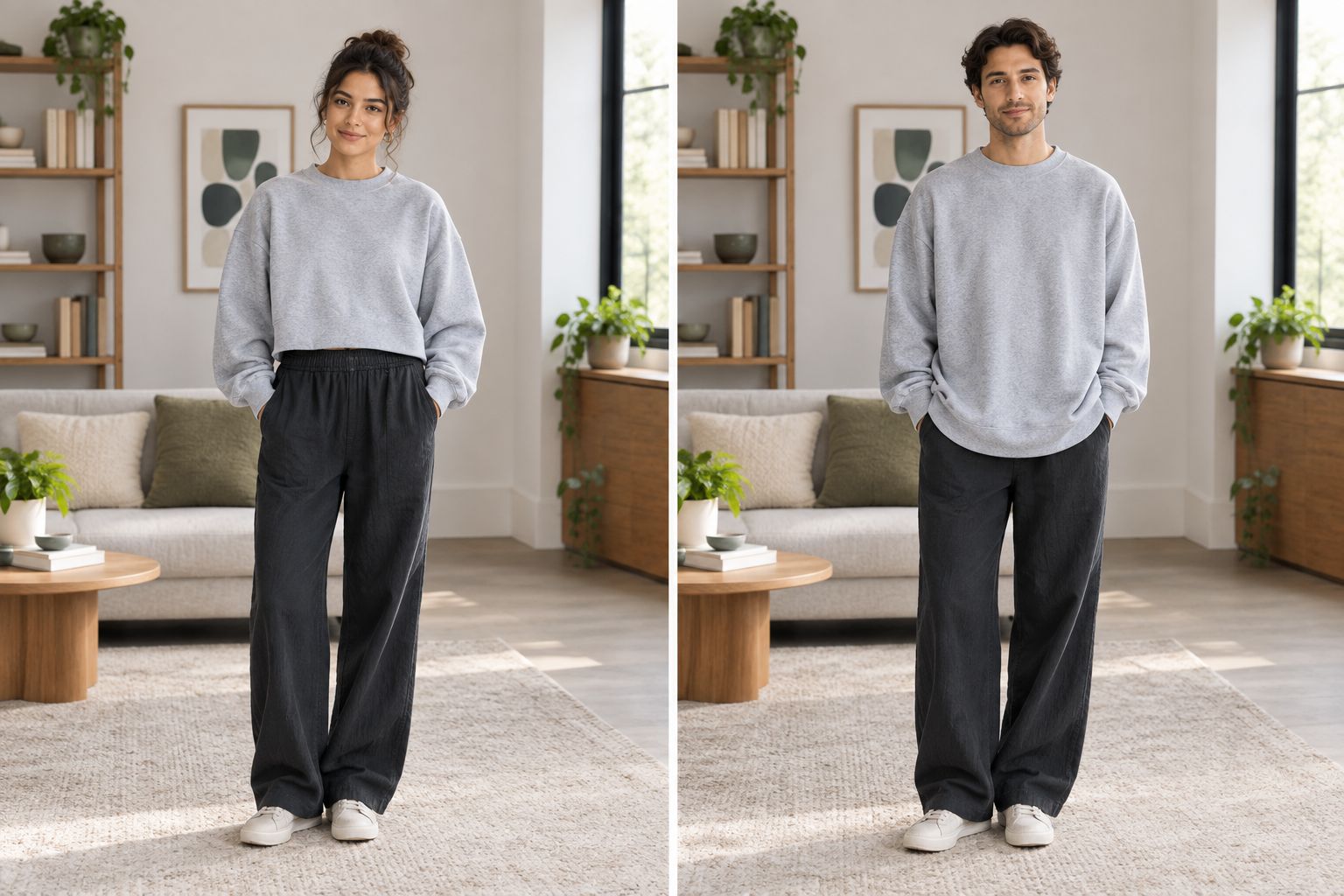
Cropped oversized crewneck pros:
- Keeps the waistband part of the outfit.
- Combines upper-body width with less torso length.
- Lets trouser shape begin visibly beneath the sweatshirt.
Cropped oversized crewneck cons:
- Offers less torso coverage than a longer cut.
- The hem rises further when you lift your arms.
- Requires attention to the relationship between body length and trouser rise.
Best for: You want wide sleeves and a roomy torso without covering the waistline.
Move before deciding. Reach forward, sit down, and raise your arms. The standing mirror view is only one version of the fit; choose the coverage you want during normal movement as well.
Verdict: Buy the cropped oversized crewneck for waist-defined outfits. Skip it when consistent torso coverage matters more.
4. Longline oversized crewneck: best for an elongated top
A longline oversized crewneck makes length part of the statement. The hem sits farther down the body than a shorter alternative. Choose that effect deliberately instead of arriving there by buying a larger size.
Start with trousers that create a clear line below the hem. If you prefer volume throughout, keep it. Just recognize that an elongated top hides more of the trouser rise and changes where the outfit appears to divide.
Longline oversized crewneck pros:
- Gives you a deliberately longer upper silhouette.
- Provides more torso coverage than a cropped alternative of comparable fit.
- Makes the sweatshirt hem a clear styling element.
Longline oversized crewneck cons:
- Covers waistbands, belts, and upper pocket details.
- Can collect fabric when worn beneath a shorter jacket.
- Extra length does not fix an uncomfortable shoulder or neckline.
Best for: You want an elongated sweatshirt silhouette rather than a boxy one.
Check the hem against your outerwear. A visible sweatshirt below a jacket can be intentional. A hem that repeatedly catches or folds beneath the jacket is a practical problem, not a styling requirement.
Verdict: Buy the longline oversized crewneck when length is the point. Skip it if you want the waistband visible.
5. Lightweight relaxed crewneck: best for layering
A lightweight relaxed crewneck puts less emphasis on substantial fabric. Choose it when the sweatshirt needs to fit beneath another garment rather than define the entire outfit alone.
Compare it with your actual jacket, not an imagined one. Put both on. Check the shoulders, elbows, and cuffs, then close the jacket to see whether the combination restricts movement.
Lightweight relaxed crewneck pros:
- Reduces fabric bulk compared with a heavier garment of similar construction.
- Gives you a crewneck layer without adding a hood.
- Suits outfits where the outer garment supplies the main shape.
Lightweight relaxed crewneck cons:
- Does not deliver the same substantial feel as heavyweight fabric.
- A soft fabric can follow the body rather than hold a distinct outline.
- Lightweight is not a guarantee of breathability or comfort.
Best for: You wear your sweatshirt beneath jackets and want less bulk.
For layering in 2026, check the complete outfit. A sweatshirt that looks right alone can behave differently beneath an outer layer. The useful purchase is the one that works in the combination you actually wear.
Verdict: Buy the lightweight relaxed crewneck for layering. Skip it when substantial fabric is your main requirement.
Read the garment, not just the weight
Bandits Outlaws lists its Frank Lucas Heavyweight Sunfade Oversized Hoodie as 100% cotton, with fabric weight of 400 g/m², also stated as 11.8 oz/yd². Its supplied care instructions specify machine washing at 30°C on a gentle cycle.
Those details belong to that hoodie. They are not specifications for an oversized crewneck sweatshirt, and they do not establish a universal weight threshold for a good crewneck.
Use that distinction when shopping in 2026. Composition tells you what the stated fabric contains. Fabric weight tells you its mass per area. Neither tells you the shoulder position, body length, or hem shape on your body.
Bandits Outlaws also describes limited drops and no restocks as intentional production choices. Treat that as context, not pressure. A production philosophy does not replace a fit decision.
How these fits are ranked
The ranking puts a defined standalone silhouette first, everyday flexibility second, and more specific styling needs afterward. It uses body shape, shoulder position, hem behavior, fabric behavior, and outfit compatibility—the criteria above.
This is a styling ranking, not a claim that one named product outperformed another. The heavyweight boxy crewneck wins the shape-first brief. The lightweight relaxed crewneck wins the layering brief. Changing your brief changes your best choice.
Before choosing, use this sequence:
- Choose the role: Standalone top or layer beneath a jacket.
- Choose the length: Waistband visible or covered.
- Check movement: Sit, reach, and raise your arms.
- Check the outfit: Wear your usual trousers and outerwear.
Which oversized crewneck sweatshirt should you choose?
Choose a heavyweight boxy crewneck if you want a clear, substantial silhouette. It is the first pick for a shape-led outfit. Keep the hem and shoulder fit under scrutiny; heavyweight does not excuse a cut that fights your body.
Choose the straight-hem relaxed crewneck if you are undecided. It avoids making either a cropped or elongated body the central commitment. Choose lightweight instead when layering is the primary job.
For 2026, buy toward the outfit you repeat. Not the outfit you imagine wearing once.
FAQ
What's the best oversized crewneck sweatshirt fit?
A heavyweight boxy crewneck is the best fit for a defined standalone silhouette. Choose a straight-hem relaxed crewneck for everyday balance or a lightweight relaxed crewneck for layering.
Should I size up to get an oversized crewneck sweatshirt?
Do not assume sizing up creates an intentional oversized cut. Compare the garment's body length, width, shoulders, and sleeves with the proportions you want.
Is a heavyweight crewneck better than a lightweight one?
A heavyweight crewneck is better when substantial fabric is your priority; a lightweight crewneck is better when reducing layering bulk is the priority. Weight alone does not establish quality, breathability, or fit.
How do I wear an oversized crewneck with wide trousers?
Choose the sweatshirt length deliberately and check the complete silhouette. A shorter body keeps more of the waistband visible, while a longer body creates an elongated upper section.
Does a cropped oversized crewneck have to show skin?
No, a cropped oversized crewneck does not have to show skin. Coverage depends on the sweatshirt length, your torso, and the rise of your trousers, including when you move.
Is an oversized hoodie the same as an oversized crewneck?
No, an oversized hoodie has a hood and an oversized crewneck does not. Assess each garment separately rather than transferring the hoodie's specifications or fit claims to a crewneck.
What should I check before choosing an oversized crewneck in 2026?
Check body shape, shoulder position, hem behavior, fabric behavior, and outfit compatibility. Sit, reach, and try the sweatshirt with the trousers and jacket you expect to wear.
One last thing
Photograph the side view. Then put your arms forward.
A sweatshirt can look controlled from the front and collect fabric at the back or hem during movement. Choose the shape that works off-camera. Presence is not a pose.